



Robotic Joint Replacement

Computer-Assisted Navigation System
Computer assisted joint replacement surgery is perhaps the most important breakthrough in the history of artificial joint replacement. Using a computer, our surgeons can quickly construct a precise model of the patient's diseased joint and position the artificial joint implants with greater accuracy. Now widely used in knee and hip replacement surgery, this technique vastly improves clinical outcomes and the longevity of the artificial joint.

Total Knee Replacement
What is a total knee replacement?
In a total knee replacement, the damaged joint surfaces of the knee are removed, and metallic and special plastic prostheses are placed on the joint surfaces.
When would a total knee replacement be required?
When the knee joint is badly damaged and other treatment methods do not relieve the symptoms, a total knee replacement can ease pain and enable the patient to regain motion. The walking ability of the patient will usually be greatly improved after the operation.
Common diseases that damage the knee joint:
- Primary osteoarthritis related to age
- Rheumatoid arthritis
- Post-traumatic arthritis
How long can the total knee replacement last?
Based on past experience, a newly designed implant can last around 15 to 20 years. The longevity of the implant also depends on how vigorously the replaced knee will be used.
How does the navigation system work in a total knee replacement?
The navigation system comprises a computer, an infrared camera that emits and receives infrared signals, and an instrument that reflects the infrared signals, as well as specially designed software.
In a total knee replacement, this system uses infrared technology to produce a model of a patient’s knee joint during the operation. Making use of the specialised software helps the surgeon know exactly where to cut and place the prosthesis in the best position. A properly positioned total knee prosthesis ensures it will last longer.
Minimal invasive total knee replacement
Total knee arthroplasty techniques are evolving, and surgeons are using smaller incisions to reduce the surgical trauma to the soft tissues and, hence, lead a faster recovery.
Pre-operative preparation
- General body check (blood tests, ECG, Chest X-ray)
- Stabilisation of existing diseases such as hypertension, diabetes mellitus, heart disease, etc.
- Eliminating potential sources of infection is essential before surgery. Areas commonly requiring attention include dental caries, fungal infection of the feet and urinary tract infection
Post-operative preparations
- Three to four hours after the operation when the condition is stable, the patient can start eating again. Patients usually prefer light food such as congee or soup. An intravenous drip will be kept for the first day to replenish fluid loss.
- Analgesics will be given to the patient to reduce pain in the knee, which may last around three to four days.
- Drains from the wound to plastic bottles at bedside will help to remove any blood clots within the knee joint after the operation. These will be removed two to three days later.
- If the patient cannot pass urine, he/she may require a urinary catheter. It will usually be removed in two to three days.
- Breathing and mobilisation exercises of the lower limbs are encouraged to prevent chest infection and deep vein thrombosis.
- By the second day after the operation, many patients can sit in a chair. Some can start walking with assistance from the physiotherapists. Appropriate walking aids can be arranged.
What are the potential complications and risks of the operation?
The rate of serious complications following a total knee replacement is around 1–2%. The common ones are:
- Heart attack, stroke, etc.
- Wound infection or delayed wound healing
- Excessive bleeding
- Deep vein thrombosis, pulmonary embolism, fat embolism
- Fractures
- Nerve palsy
- Loosening of the prosthesis etc.
Related prosthetic & orthotic services
A leg sling will be provided to support the affected leg. Early in-bed exercises are encouraged to promote faster rehabilitation and reduce swelling.

Robotic Knee Replacement
Robotic Interactive Orthopaedic (RIO) System for Partial Knee Replacement
The knee joint has three parts: the patellofemoral, medial and lateral femorotibial joints. A total knee replacement can be performed if the whole joint is damaged and other treatments have failed. If only part of the joint is affected, a Partial Knee Replacement can be considered.
Computer-assisted navigation system (CANS) has been widely used in total knee replacement for about 10 years with very good clinical results. Along with the rapid development of robotic surgery, the combination of CANS and robots have made a new breakthrough in Partial Knee Replacement surgery.
In the past, Partial Knee Replacement was not widely practised by orthopaedic surgeons, mainly because the positioning of implants was often suboptimal. The Robotic Interactive Orthopaedic System (Makoplasty), however, combines the advantages of both CANS and robots to achieve high precision and accuracy during surgery. The error in positioning assessment is less than 1 mm or 1 degree.
Prior to knee replacement surgery, the patient undergoes a CT scan of the knee. The data obtained is then analysed using specialised to generate a 3D model of the knee. Based on this model, surgeons can develop a precise pre-operative plan to ensure accurate implant positioning.
During the procedure, CANS allows surgeons to assess soft tissue tension in real time, fine-tune bone cuts and achieve highly precise implant positioning. Once the plan is completed, the surgeon guides the robot to remove the damaged knee bone surfaces. The implants are then securely cemented into place.
What are the advantages of a RIO Partial Knee Replacement?
- Compared with traditional methods, it is minimally invasive with a small wound, less pain and faster recovery times
- Less bone and soft tissues of the knee are removed, thereby preserving function of the joint
- Less difficult than a total knee replacement if needed in future
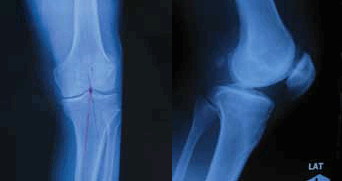
X-Ray Images of the Knee before Robotic Unicompartment
Knee Replacement
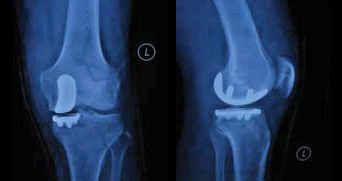
X-Ray Images of the Knee after Robotic Unicompartment
Knee Replacement
What are the indications for a RIO Partial Knee Replacement?
When the knee joint is partially damaged and other forms of treatment have failed, a Robotic Interactive Partial Knee Replacement can be performed. Common diseases causing partial knee joint damage include:
- Primary osteoarthritis of the knee
- Osteonecrosis of the femoral condyle
- Post-traumatic knee arthritis
With the RIO System, surgeons can replace just the patellofemoral, medial or lateral femorotibial joint, or any combination of these joints.
What are the potential complications and risks of the operation?
The risk of serious complications from RIO Partial Knee Replacement is low. Common ones include:
- Heart attack, stroke, etc.
- Wound infection
- Excessive blood loss
- Deep venous thrombosis, pulmonary embolism and fat embolism
- Fracture
- Neurovascular damage
- Loosening of implants, etc.

Total Hip Replacement
What is a total hip replacement?
In a total hip replacement, the diseased hip joint is replaced with an artificial joint. If the hip has been damaged, common activities such as walking or getting in and out of a chair may be painful and difficult. If medication, changes in your everyday activities and/or walking aids do not help, you may want to consider hip replacement surgery.
A total hip replacement can relieve pain and allow you to resume normal everyday activities. An artificial joint usually lasts about 10 to 15 years.
Common indications for total hip replacement
- Osteoarthritis of the hip
- Rheumatoid arthritis
- Avascular necrosis of the femoral head
- Fractured neck of femur
- Benign or malignant tumours affecting the hip joint
- Other arthritic diseases of the hip joint
Pre-operative care
- Blood test, hip and chest X-rays and electrocardiogram
- Physiotherapy, including muscle training and breathing exercises
- No food or drink 6 hours before surgery
- Cleansing of the area to be operated
- If you have any medical conditions, such as cardiac disease, hypertension, diabetes mellitus, anaemia, asthma etc., please consult your doctor
- The operation normally takes about 3 to 4 hours
Post-operative care
- If your condition is stable, you may take food 4 to 6 hours after surgery. You will be given intravenous fluid supplement or blood transfusion if necessary
- You will be given oral, intramuscular, intravenous or other analgesics to control pain
- An abduction pillow will be placed between your legs to prevent dislocation of the replaced hip
- The drains inserted in the surgical wound will be removed 2 to 3 days after surgery
- Doctors usually insert a urinary catheter prior to the surgery for patient comfort after surgery. The catheter will be removed 2 to 3 days after surgery
- During the first 2 to 3 days after surgery, most patients can start walking and sitting. It is recommended to sit on a high chair to avoid too much flexion of the hip joint to prevent dislocation. Patients are also advised to use a toilet commode to avoid too much flexion of the hip joint
- Deep breathing and exercises for the feet and ankles to prevent lung infection and deep vein thrombosis
- You can resume standing and walking under supervision of the physiotherapist
- You may need to stay in the hospital for one to two weeks after surgery, following which additional visits to the hospital are recommended for physiotherapy
To prevent dislocation of the operated hip joint:
- Do not cross your legs
- Do not bend down to pick up items
- Do not sit on low chairs or a sofa
Possible complications
The rate of serious complications following hip replacement surgery is low. They may include:
- Deterioration of pre-existing diseases cardiac disease, hypertension, stroke, diabetes mellitus, etc.
- Wound infection or delayed wound healing
- Bleeding from the wound or haematoma formation
- Deep vein thrombosis, pulmonary embolism, fat embolism
- Dislocation of the replaced hip or infection
- Loosening of the prosthetic joint
- Nerve palsy
- Prolonged bed rest leading to pressure sores, etc.


Happy Valley
- Address:
- 2/F, Li Shu Fan Block,
Hong Kong Sanatorium & Hospital,
2 Village Road, Happy Valley, Hong Kong
- Service hours:
-
Monday to Friday: 10:00 am - 6:00 pm
Saturday: 11:00 am - 3:00 pm
Closed on Sundays and Public Holidays
Consultation by Appointment
- Tel.:
- (852) 2835 7890
- Email:
- [javascript protected email address]
- Fax:
- (852) 2892 7517
- WhatsApp:
-
(852) 2835 7890
(For non-emergency cases)