



Cosmetic Eyelid Surgery

Cosmetic eyelid surgery is primarily used for creating double eyelid folds, correcting eye puffiness or eye bags, addressing vision obstruction caused by droopy eyelids, and correcting asymmetry of the eyes, thereby improving both vision and appearance.
Upper Eyelid Surgery
Upper eyelid surgery is popular in Asia, where a double lid crease is formed surgically for patients with a single eyelid crease, or for patients with excessive skin overhanging the upper eyelid.
Forming an upper lid crease can make the eyes appear larger. This procedure can be as simple as placing suturing loops without major cuts to elevate the skin and increase folds. It requires a shorter recovery time, but is generally less durable. The full incision method, which tends to be more lasting, involves making an incision on the upper eyelid skin and placing stitches to form the lid crease.
For eyelid skin that has become loose and sagging due to ageing, surgical excision of the excess skin can be considered. This procedure not only creates a more youthful appearance but also improves the visual field issue due to overhanging skin.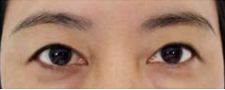
Before Surgery
After Surgery
Lower Eyelid Surgery
"Eye bags" are caused by the protrusion of fat, giving the impression that the person looks aged and constantly tired. One method of treating eye bags involves removing the fat through a small incision in the conjunctiva, then extracting and excising the fat. The advantage of this transconjunctival approach is that it leaves no scar on the skin.

Before Surgery
A Day after Surgery: No more lower eye bags, no bruises and minimal swelling.
- Ptosis
Ptosis is a condition characterised by the drooping of the upper eyelid, which can affect one or both eyes. Symptoms may include an impaired field of vision and a tired appearance. Ptosis occurs when the levator muscle, responsible for lifting the eyelid, weakens or degenerates, often due to ageing. However, droopy eyelids can also result from factors such as long-term contact lens use, frequent vigorous rubbing of the eyes, or neurological conditions like myasthenia gravis, oculomotor nerve palsy, or Horner's syndrome. It is crucial to promptly identify the cause if ptosis occurs. If the ptosis is due to a neurological issue, it may severely affect the patient and even be lifethreatening, requiring immediate medical attention. For ptosis due to the loosening of the levator muscle, surgical correction is effective. The surgery can be performed through either a skin or conjunctival incision, with the latter leaving no skin scar.


Happy Valley
- Address:
- 4/F, Li Shu Fan Block,
Hong Kong Sanatorium & Hospital,
2 Village Road, Happy Valley, Hong Kong
- Service hours:
-
Monday to Friday: 9:00 am - 5:00 pm
Saturday: 9:00 am - 1:00 pm
Closed on Sundays and Public Holidays
Consultation by Appointment
- Tel.:
- (852) 2835 8880
- Email:
- [javascript protected email address]
- Fax:
- (852) 2892 7510
- WhatsApp:
-
(852) 2835 8890
(For non-emergency cases)


Admiralty
- Address:
- 21/F, One Pacific Place,
88 Queensway, Hong Kong
- Service hours:
-
Monday to Friday: 9:00 am - 5:00 pm
Saturday: 9:00 am - 1:00 pm
Closed on Sundays and Public Holidays
Consultation by Appointment
- Tel.:
- (852) 2855 6700
- Email:
- [javascript protected email address]
- Fax:
- (852) 2523 7660
- WhatsApp:
-
(852) 2855 6700
(For non-emergency cases)