



Overview
The cornea is a clear, transparent structure at the front part of the eye. It provides a window for light to enter and focus into the eye. Cornea diseases can be due to
- Degeneration
- Infections
- Injuries
- Congenital
Any damage to the cornea can eventually result in scarring or deformation and light cannot be focused into the eye. Corneal transplantation replaces the damaged cornea with a donor cornea. In HKSH, we offer all types of corneal transplantation with an option to apply donor tissue from overseas eye banks, thereby greatly reducing the waiting time for surgery.
Procedures and Treatments
Cornea scarring/Deformities
Penetrating Keratoplasty
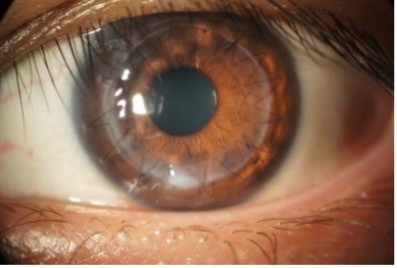
Penetrating Keratoplasty involves the removal and replacement of all layers of corneal tissues. During the procedure, a circular cutting device is used by surgeon to cut the donor cornea and remove a circular disc of cornea. A second device is then used to remove a similar sized portion of the patient's cornea. The donor tissue is then sewn in place with sutures. This is a traditional method of corneal transplantation.- Lamellar keratoplasty/Deep Anterior Lamellar Keratoplasty
During this procedure, the anterior layers of the central cornea are removed and replaced with donor tissues. Endothelial cells and Descemet membrane (and part of the stroma in case of Lamellar keratoplasty) are left in place. This technique is used to treat anterior corneal opacifications and scars. - Endothelial Keratoplasty
This relatively new procedure has revolutionized the treatment of disorders of the innermost layer of the cornea (endothelium). It replaces the patient's endothelium with a transplanted disc of posterior stroma/Descemet’s membrane/endothelium (DSAEK) or Descemet’s membrane/endothelium (DMEK). Unlike a full thickness corneal transplant, this surgery can be performed with one or no suture. Patients may recover functional vision in weeks to months as opposed to up to a year with full thickness transplants.
The patient's corneal endothelium is removed and replaced with donor tissue. With DSAEK, the donor tissue includes a thin layer of stroma, as well as endothelium, which is commonly 100–150 µm thick. With DMEK only the endothelium is transplanted. In the immediate post-operative period the donor tissue is held in position with a gas bubble placed inside the eye (the anterior chamber). The tissue self adheres in a short period and the gas is absorbed by the surrounding tissues. Artificial Cornea
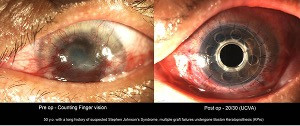
The Boston Keratoprosthesis (KPro) is the most widely used artificial cornea or keratoprosthesis. It is a treatment option for corneal disease not treatable with corneal transplant techniques mentioned above or for patients with multiple cornea graft rejections.
Limbal Stem Cells Deficiency
A clear transparent cornea is supported by a group of cells that surrounds the clear cornea. This special group of cells is called limbal stem cells. In some diseases like chemical burn and certain autoimmune diseases, these stem cells are destroyed and the corneal erosion cannot heal or left with permanent scars.
The following treatment options are available to help this group of patients:
- Autologous Serum
Autologous serum is a blood-derived eye drop, in which the donor and recipient are the same individual. The serum is created by extracting blood from the patient. It then undergoes clotting and centrifuging. The serum is subsequently transferred to eye drops bottle for patient use. It promotes healing and is particularly helpful in this group of patients. - Amniotic Membrane Transplant
Amniotic membrane is the innermost layer of the placenta. It has been used as a graft or as a dressing to reconstruct the ocular surface or as a bandage to promote healing in cases of persistent epithelial defects or ocular surface inflammation. Depending on the patient’s condition, the doctor may use either a cryopreserved amniotic membrane or a processed, dehydrated, sterilized human amniotic membrane tissue . - Simple Limbal Epithelial Transplantation (SLET)
Simple limbal epithelial transplantation (SLET) involves harvesting healthy limbal stem cells from a healthy eye for implantation into the diseased eye to restore corneal transparency and prevent scarring. The donor’s cells can also be derived from donated corneas from eye bank. This is particularly helpful in patients suffering from chemical burns or autoimmune diseases where the limbal stem cells are damaged.
Keratoconus
In keratoconus, the cornea gets thinner and gradually bulges outward into a cone shape.
A cone-shaped cornea causes blurred vision and may cause sensitivity to light and glare. Keratoconus usually affects both eyes and usually develops in late teens and around 30 years of age.
- Corneal Collagen Crosslinking
Corneal collagen crosslinking (CXL) is a minimally invasive procedure used to prevent progression of corneal ectasia by improving the structural integrity of the cornea - Topography-guided Surface Ablation
This technology has been developed to treat corneal irregularities. It has also been used in patients with keratoconus. Under the guidance of “corneal maps”, laser is targeted to specific locations to reduce corneal irregularities. It is also effective in treating corneal scars and corneal irregularities caused by other diseases or traumas.
Contact Us

Happy Valley
- Address:
- 4/F, Li Shu Fan Block,
Hong Kong Sanatorium & Hospital,
2 Village Road, Happy Valley, Hong Kong
- Service hours:
-
Monday to Friday: 9:00 am - 5:00 pm
Saturday: 9:00 am - 1:00 pm
Closed on Sundays and Public Holidays
Consultation by Appointment
- Tel.:
- (852) 2835 8880
- Email:
- [javascript protected email address]
- Fax:
- (852) 2892 7510
- WhatsApp:
-
(852) 2835 8890
(For non-emergency cases)

Admiralty
- Address:
- 21/F, One Pacific Place,
88 Queensway, Hong Kong
- Service hours:
-
Monday to Friday: 9:00 am - 5:00 pm
Saturday: 9:00 am - 1:00 pm
Closed on Sundays and Public Holidays
Consultation by Appointment
- Tel.:
- (852) 2855 6700
- Email:
- [javascript protected email address]
- Fax:
- (852) 2523 7660
- WhatsApp:
-
(852) 2855 6700
(For non-emergency cases)

Admiralty
- Address:
- 21/F, One Pacific Place,
88 Queensway, Hong Kong
- Service hours:
-
Monday to Friday: 9:00 am - 5:00 pm
Saturday: 9:00 am - 1:00 pm
Closed on Sundays and Public Holidays
Consultation by Appointment
- Tel.:
- (852) 2855 6699
- Email:
- [javascript protected email address]
- Fax:
- (852) 2523 7660
- WhatsApp:
-
(852) 2855 6699
(For non-emergency cases)

Happy Valley
- Address:
- 6/F, Central Block,
Hong Kong Sanatorium & Hospital,
2 Village Road, Happy Valley, Hong Kong
- Service hours:
-
Consultation by Appointment
- Tel.:
- (852) 2835 8890
- Email:
- [javascript protected email address]
- Fax:
- (852) 2892 7538

Admiralty
- Address:
- 22/F, One Pacific Place,
88 Queensway Hong Kong
- Service hours:
-
Consultation by Appointment
- Tel.:
- (852) 2855 6700
- Email:
- [javascript protected email address]
- Fax:
- (852) 2892 7429